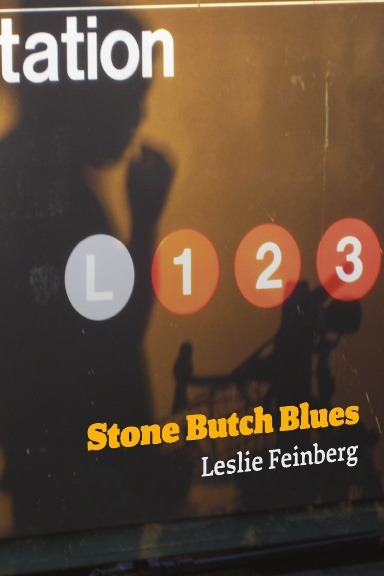
Stone Butch Blues is a cult classic. Readers across the LGB and TQ spectrum have found recognition and sustenance in Leslie Feinberg’s magnum opus. First published in 1993, it tells the story of Jess Goldberg, who knows from a young age that she doesn’t fit the cultural expectations attached to girlhood – and has no desire for a future defined by marriage and motherhood.
Jess runs away after being institutionalized by her parents, and finds a spiritual home in Tifka’s – a lesbian bar. There she’s adopted by Butch Al, who schools Jess in the art of female masculinity, and Jackie, who gently guides Jess through the unspoken rules holding the lesbian bar scene together.
Though Jess finds belonging in her new community, safety doesn’t exist for women living on the margins of society. Cops frequently raid lesbian bars, raping and torturing butches in police custody. And even when she can find work in factories, Jess is vulnerable to violence from men who believe butches are stealing their jobs or promotions. Jess lives a precarious life. And she spends the whole novel figuring out how to survive in this world while also being true to herself and others.
Stone Butch Blues is important not only because it’s told in such a heartfelt way, but because it lovingly documents and celebrates lesbian bar culture. For all the gains in gay rights since Feinberg wrote this novel, the sad fact is there were more lesbian bars in the early ‘90s than the present day. But Stone Butch Blues preserves those memories, adding to the novel’s cultural significance.
Stone Butch Blues is also notable for offering one of fiction’s earliest depictions of medical transition – and being the first novel about a desister (someone who detransitions). Feinberg and her book are both celebrated for contributing to transgender history and politics. To anyone who has read the novel – and indeed in the eyes of the author – it’s clear there’s no clash between Stone Butch Blues being considered a lesbian novel and a transgender one. After all, as the author’s life demonstrates, the boundary between butch lesbian and transgender man is far from concrete.

In the Author’s Note to the 20th Anniversary edition, Feinberg wrote that “Like my own life, this novel defies easy classification. If you found Stone Butch Blues in a bookstore or library, what category was it in? Lesbian fiction? Gender studies? Like the germinal novel The Well of Loneliness, by Radclyffe/John Hall, this is a lesbian novel and a transgender novel—making ‘trans’ genre a verb, as well as an adjective.”
Feinberg writes about gender with a cool pragmatism that is often missing from today’s heated debates. For Jess, transition is a survival strategy. After multiple rapes at the hands of police, violent acts of sabotage by sexist colleagues, and profound isolation in the aftermath of these traumas, Jess has had enough. The world punishes her relentlessly for being an unconventional woman, so she tries living as a man.
Her escape from womanhood allows Jess to blend in more, with facial hair and a deep voice enabling her to pass for male – and escape from male violence. But being exiled from womanhood – and a community of women who love other women – only adds to Jess’s loneliness. And she quits taking testosterone. But not before committing one of the novel’s most terrible acts.
Thanks to her education from Butch Al and Jackie, Jess is well versed in butch gallantry. She’s gentle with her partners, emotionally and physically, treating women with great consideration. Until Annie. Jess seduces Annie, a waitress and single mother who believes that she is male. Jess is fully aware that Annie wouldn’t date her or sleep with her if she knew Jess were female.
Jess keeps the lights off, to hide her mastectomy scars and strap on. She rolls a condom onto her dildo and promises to pull out, because Annie is afraid of getting pregnant again. And she lies so that Annie will agree to sleep with her. Jess is so absorbed in trying to cure her own loneliness that she takes away any opportunity for Annie to give informed consent or turn her down.
This is sex by deception. And sex by deception is rape. The scene between Jess and Annie is never acknowledged as an act of sexual violence – not even during the novel’s conclusion, when Jess tries to make amends to anyone she has wronged after a near-death experience. And there is nobody she wronged more than Annie.
Jess doesn’t leave Annie out of guilt or responsibility. She ends the relationship after Annie uses a homophobic slur and implies gay people are sexually abusive. And there’s an irony to Jess’s moral outrage, given her own predatory behavior.
It must be said: the cruelty with which Jess treats Annie doesn’t fit her characterization, nor the ethos of the book outside this scene. Feinberg otherwise does an incredible job of showcasing the beauty and tenderness of lesbian desire. Which is perhaps why critical discussion of that rape scene is typically missing from conversations about her legacy. And at a time when “problematic” media is widely condemned by the queer left, and the #MeToo movement has brought discussions of sexual violence into the mainstream, this feels like a glaring omission.
Stone Butch Blues is often revered as revolutionary. And it’s certainly countercultural, affirming the worth and dignity of lesbian and gender non-conforming women in a society where we are despised. But there are real limitations around how Feinberg depicts feminine women. Whereas the butches have adventures, character arcs, and complex inner lives, the femmes exist primarily as their support system.
Feinberg’s femmes cook and clean, doling out sage advice and drying butch tears. They are conquests, dispensing sexual healing and shoring up butch pride. Many of the femmes work the streets to make a living – and while research shows that women who survive prostitution have higher rates of PTSD than soldiers returning from war, there’s no space in this novel for their trauma to be addressed; for femmes to receive rather than give support. Indeed, those conversations are actively suppressed on the grounds that butches don’t like to think of “their” women with anyone else.
Most troubling of all, the femmes in this novel are framed almost as property. Jackie plays a pivotal role in shaping the woman Jess grows into, a positive influence from the moment they meet. And yet – in spite of her significance to the plot – Jackie is first introduced as “Butch Al’s femme.” Not a person in her own right, but an extension of Al.
Perhaps if this possessiveness extended both ways it would balance out. But there’s no point in the novel where Al or any other butch is defined primarily by her relationship with a femme. And there are several where a butch accuses another butch of having designs on her femme. It borders on chauvinism. Just as Jess’s disgust at learning two butches are in love with one another echoes homophobia.
Despite these faults, Stone Butch Blues is worth reading. Feinberg brings to life a rich world with a vibrant cast of characters. It’s impossible not to care about Jess or the lesbians who make up her community. And though it might have been tempting to take refuge in sameness, Feinberg does a truly remarkable job of highlighting how race and class shaped women’s relationship with lesbian spaces and politics.
Jess is an introspective protagonist who invites the reader to think more deeply, appreciate the beauty in small things, and – most importantly – to hold compassion for the people around us.